Reading / 01 / Digital logic
Two states,
many possibilities
Digital complexity begins with simple relationships. Binary states provide a small vocabulary; logic gives those states a way to interact.
An educational technology note.
01A state becomes a symbol
A bit is a binary digit: a value written as zero or one. In a physical circuit, those symbols usually correspond to two ranges of electrical conditions. The symbols are an abstraction; a wire does not contain a tiny printed numeral.
Using two distinguishable states lets a circuit represent information and apply repeatable rules to it. The meaning comes from the arrangement and interpretation of those states. A group of bits might represent a number, part of a letter or a control instruction, depending on the surrounding system.
02Small rules, combined
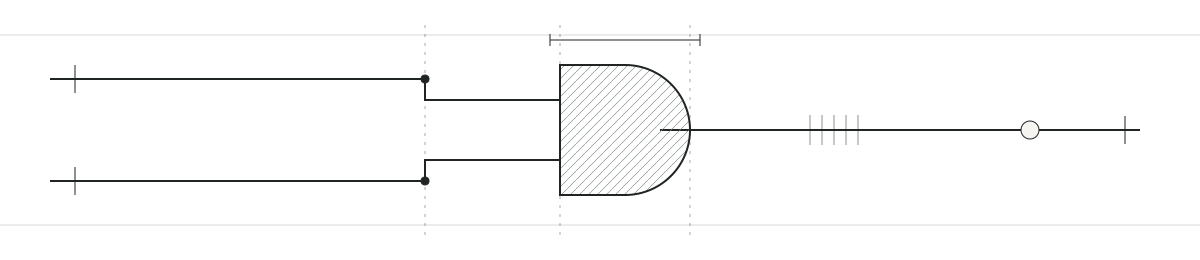
A logic gate produces an output from one or more inputs according to a defined relationship. An AND gate has a one output only when both inputs are one. An OR gate has a one output when either input, or both, is one. A NOT gate reverses a single binary input.
These are logical descriptions, rather than claims about the shape of a component. Combining gates creates more elaborate behavior. Some circuits calculate an output from current inputs; others include stored state so that earlier events can affect what happens next.
Hypothetical teaching example
Two conditions, one output
Imagine an indicator that should light only when two switches are active. Treat each active switch as one. The simplified AND relationship is:
| Switch A | Switch B | Indicator |
|---|---|---|
| 0 | 0 | 0 |
| 0 | 1 | 0 |
| 1 | 0 | 0 |
| 1 | 1 | 1 |
This table is a teaching model, not a complete wiring design or a safety-control specification.
03The physical details still matter
A logical rule describes which result is expected, but does not tell the whole physical story. Signals take time to change. Components have electrical limits. A real design must account for timing, voltage ranges and the conditions under which an input is interpreted.
The distinction is useful when reading about computers. A logical description explains a relationship; a hardware description explains how that relationship is implemented. Neither a gate count nor a clock frequency, on its own, explains everything a complete machine can do.
These concepts describe technology in general. They do not describe activities or services of STYLECRAFT PLUS LLC.